

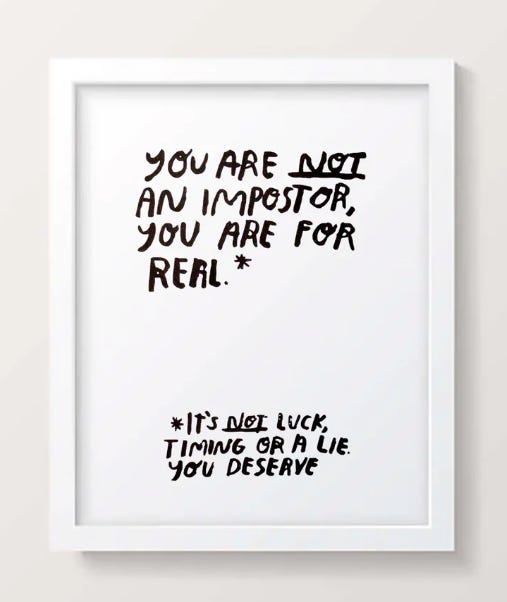
Imposter syndrome is the internal experience of believing that you are not as competent as others perceive you to be. If you have ever experienced self-doubt, chances are you have also encountered imposter syndrome, the voice in the back of your head doubting your abilities and telling you that you are a fraud.
Imposter syndrome sounds like:
"I have no idea what I am doing, who am I to teach a class?"
“I have never done XYZ, who am I to promote myself and my work?”
"Nobody is buying my products, why would anyone want what I made?"
"I am not talented enough or smart enough or __________ enough to achieve my goals."
Almost every woman I know has struggled with imposter syndrome at some point in their life, mostly thanks to years of conditioning with a side of social media mixed in. Women have been taught to play small, to limit themselves, and to speak only when we are spoken to. Women have been taught to be good girls and to fit into tiny little boxes or more recently tiny little squares on the internet.
If you feel like, or have ever felt like, an imposter, it is only because life requires doing things that you have never done before. Chances are if you are stepping out of your comfort zone imposter syndrome will surface to scare you out of trying something new.
Imposter syndrome showed up for me most when I began to identify and step into my purpose. The idea of starting a business was particularly terrifying for me and I seriously considered staying in my lane and embracing my ‘good enough’ life just as it was. I repeatedly told myself my dream was meant for someone else to achieve, until I simply couldn’t silence it anymore.
I have spent the past 5 years stepping outside of my comfort zone and actively silencing my own thoughts of being an imposter ever since. It doesn’t matter what industry you are in or how big your dreams might be, there will always be someone who is further along than you and chances are following along with their growth will make you feel like an imposter. Just because someone is already doing the thing you want to be doing does not mean you are not meant to be tackling your own version of that dream.
Identifying and actively challenging our imposter syndrome allows us to move through it and ultimately grow into exactly who we were always meant to be.
Grab a piece of paper and answer the following questions:
I most feel like an imposter when:
My imposter often sounds like:
I would feel less like an imposter if:
People I’ve Loved perfectly captured these sentiments with this print, available here. Carissa Potter, artist and founder of People I’ve Loved, also writes on Substack and is one of my favorite follows.