

Women tend to shoulder the burden of motherhood, carrying the majority of the unpaid and emotional labor involved in parenting and raising kids regardless of job status. More often than not, mothers handle packing of lunches, scheduling childcare, and schlepping kids to and from school. They manage the doctor’s appointments, plan the playdates, cover for sick days, and keep their fridges stocked and their kids fed, all regardless of whether they work outside the home or not.
This invisible work is rarely discussed but often felt and one of the main barriers of advancement for women, often leading women to re-evaluate their schedules, priorities, and even their careers. I felt this burden first hand when returning to work after the birth of my son and struggled to voice my concerns or even understand what exactly I was feeling. Nearly two years of postpartum depression and resentment ensued before I made the heartbreaking choice to reluctantly leave my career behind to be more available for my kids; a choice I truthfully never wanted to make and one that continues to shape my life.
At the time I felt like I am carrying the weight of the world on my shoulders and the lack of resources and support were palpable. I spent my first few years of motherhood frustrated that my career and identity had taken a hit while my husbands seemingly remained in tact. Everywhere I looked I saw women who were choosing their kids over themselves, leaving behind careers and revising the lives they had built to be more ‘available’ for their families, while their partner’s continued to climb, mostly undeterred.
The more women I met, the more stories I heard, and the more I recognized how similar we all are, each of making choices and accommodations in order to raise the next generation. I’ve have met countless women who have given up or sidelined their careers in order to be home for their kids while their husbands advance their careers, similarly I’ve heard stories of women who have rebuilt their careers as consultants or freelancers in order to have more flexibility and to be closer to their kids in case of emergency, and of course I have met plenty of women who didn’t have a choice one way or another.
I have made a number of accommodations in order to be more available for my kids and my family over the years, often at the expense of myself and it is one, of many, reasons I feel so strongly about the work I do. Although it is worth noting that I am writing this with a sick kid sitting beside me, fully aware that every moment that I write is another moment that she is tethered to a screen. It is all so reminiscent of the early pandemic days and reminds me that the line between work and motherhood, labor and self-sacrifice is often blurred.
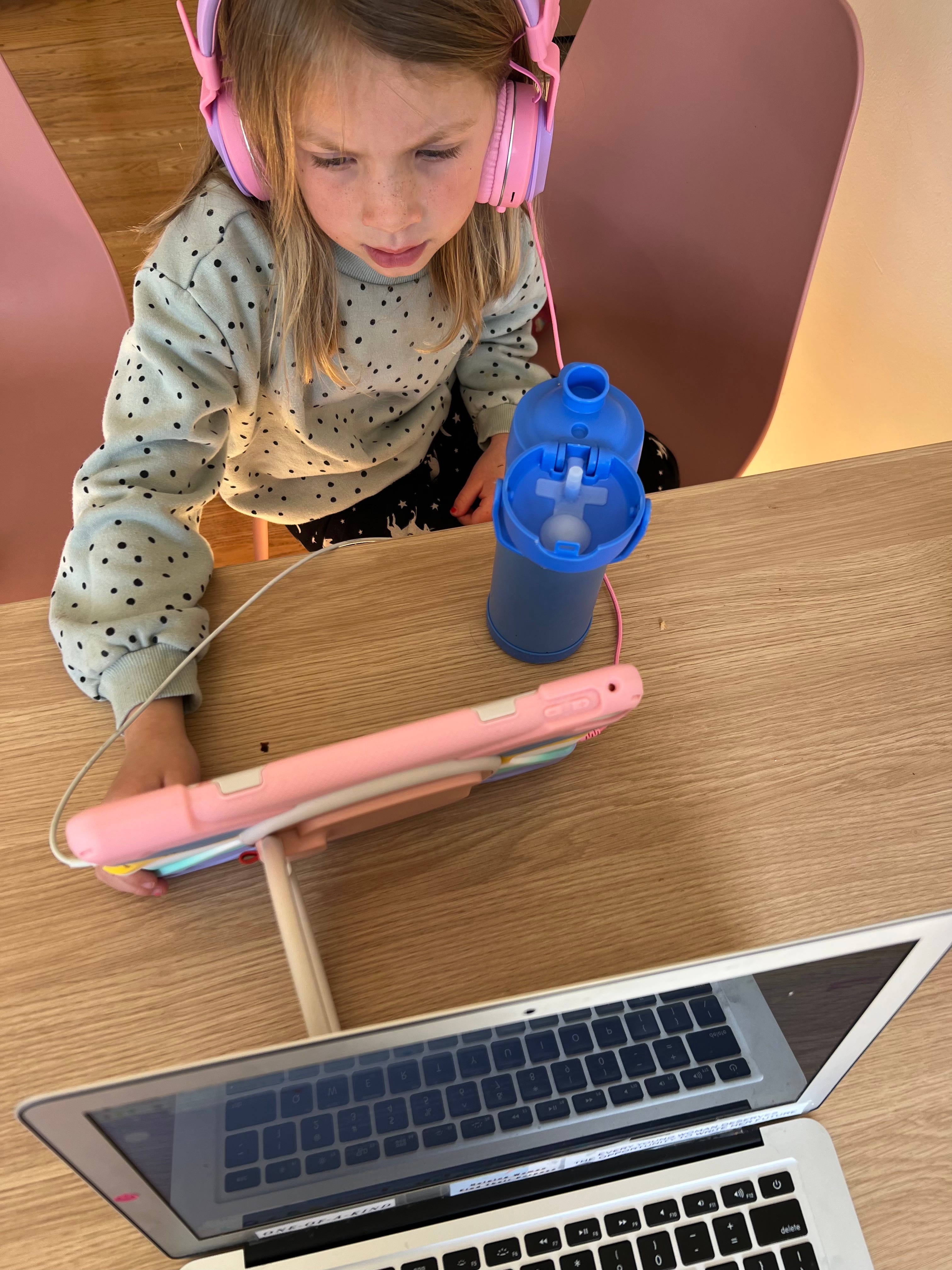
Shouldering the burden of motherhood, writing while my daughter is tethered to her screen.
I have mothered every which way over the years and the one that works best for me, and therefore my kids, always includes work. I am the best version of myself when I have the time and space to work and write and create independent of them. This isn’t about a paycheck, although having one certainly helps me carve out that time free of guilt, for me this is about staying true to myself.
Without my work I am even less available for my kids and their every changing needs. After long hours trapped at home without childcare I find myself easily frustrated, yelling more, and the absolute worst version of myself. Setting aside my own career aspirations and ambitions in an effort to be more available for my kids proved bad for both them and for me.
We live in a world of negative paychecks, a society that discredits and ignores the unpaid labor that (mostly) women do and insists that the costs incurred to raise and care for a child rests solely on the shoulders of that family. The lack of support for mothers and this idea that each family must make the choice (and sacrifice) that works best for them is infuriating.
This silent, unpaid burden continues to rest disproportionately on women while paid work elevates women, giving them power and independence and perhaps most importantly choice. It is worth noting that while privilege and power and money certainly impacts one’s ability to ‘choose’ for themselves, nobody is immune from the burden mother’s carry.
Michelle Obama said, “regardless of status or title, a tired and stressed parent is still just a tired and stressed parent at the end of the day.” She said, “People think I’m being catty for saying this — it’s like, there were 10 years where I couldn’t stand my husband. Ten years! And guess when it happened? When those kids were little.” “The minute we had kids it was like, ‘Where are you going? And how far?‘ And you start measuring — it’s like, ‘How many diapers did you change?’ and ‘Oh, you’re golfing? Oh, you got time to golf? How you at the gym all the time?’ That’s when all the measuring starts because you got this joint project.” “For 10 years while we’re trying to build our careers and you know, worrying about school and who’s doing what and what, I was like, “Argh, this isn’t even!”
“For 10 years while we’re trying to build our careers and you know, worrying about school and who’s doing what and what, I was like, “Argh, this isn’t even!” - Michelle Obama
Serena Williams recently left her career behind to try for a second kid and said, “Believe me, I never wanted to have to choose between tennis and a family. I don’t think it is fair. If I were a guy, I wouldn’t be writing this because I’d be out there playing and winning while my wife was doing the physical labor of expanding our family.” She said, “I know a lot of people are excited about and look forward to retiring, and I really wish I felt that way…praise to those people, but I’m going to be honest. There is no happiness in this topic for me. I know it’s not the usual thing to say, but I feel a great deal of pain. It’s the hardest thing that I could ever imagine. I hate it. I hate that I have to be at this crossroads. I keep saying to myself, I wish it could be easy for me, but it is not. I’m torn: I don’t want it to be over, but at the same time I’m ready for what’s next.” She continued by saying “I am going to miss that version of me, that girl who played tennis.”
“Believe me, I never wanted to have to choose between tennis and a family. I don’t think it is fair. If I were a guy, I wouldn’t be writing this because I’d be out there playing and winning while my wife was doing the physical labor of expanding our family.” - Serena Williams
Which leads me right back to where I started, why must women give pieces and parts of themselves up for motherhood? Society routinely paints the picture of a ‘good mother’ as excessively attentive, self-sacrificing, and always present. If you hired workers to do all of the unpaid work that women do at market rate, unpaid work would be the largest sector of the global economy, and yet it is hugely ignored because women carry the additional burden for free.
Questions to ask yourself:
How do you shoulder additional burden for your family?
How do you routinely show up for your kids?
What feels heavy right now?
What can you let go of to create more capacity to carry this burden?
What would make your life feel lighter?
What support do you need?
If it is too heavy, put it down.
Inspiration from this essay came from the following celebrity statements on life, work, and motherhood:
Michelle Obama was quoted in conversation during her Revolt x Michelle Obama a special event arranged as part of her book tour for The Light We Carry, the former First Lady opened up about parenthood’s effects on a marriage — including her own.
Serena Williams was quoted in a Vogue article about her retirement from tennis, “Serena Williams Says Farewell to Tennis On Her Own Terms - And In Her Own Words.”
You capture so many of these complicated and hard to deal with emotions and feelings. The topic of the hidden burden of motherhood is so hard to have - I find that even in my own home and relationship.